You know the word. You just have never heard it.
French learners can pass reading tests and still freeze in conversation. It is not a memory problem — written French hides the sound, and liaison reshapes words at every boundary. Your ears need their own copy of the vocabulary.

If you came from the thread
Silent letters and liaison mean written French and spoken French are almost two languages. Binding each word's real sound to its spelling through repeated exposure closes the gap.
The issue is often exposure frequency and friction, not only talent or motivation.
Instead of one heroic session, make words return in small repeatable moments.
Use repeated exposure as a small passive loop before the next real study session.
The spelling hides the sound
In 'ils parlent', half the letters are silent. 'Beaucoup' spends nine letters on four sounds. A learner who studies French through text builds a mental pronunciation that real French refuses to match.
Liaison reshapes the words you knew
'Vous avez' surfaces as 'vou-za-vez'. Words you could catch alone disappear into the chain of connected speech. The vocabulary did not change — its sound boundaries did.
So listening lags reading by years
Many learners read novels but cannot follow a casual conversation. The gap is systematic: every hour spent with silent text deepens the eye-vocabulary without touching the ear-vocabulary.
2 forms
French orthography preserves centuries of older pronunciation, so the mapping from spelling to sound is one of the least transparent among major Latin-script languages. Learning a word's spelling and learning its sound are genuinely separate tasks.
Stop studying French in silence
Text-first vocabulary
You learn words from lists and readings. Your eye-vocabulary grows fast, but each word is stored with a guessed pronunciation — and spoken French keeps failing to match the guess.
Sound-attached vocabulary
Every word arrives with its real sound from the first meeting, and returns as sound. When 'beaucoup' has been heard fifty times, no silent letters can hide it in conversation.
French does not have hard listening. It has vocabulary that was never learned out loud.
Give each word its sound from day one
See the spelling
Keep the written form — you will need it for reading and writing French.
Hear the real sound
Attach the spoken form immediately, before a wrong guess settles in.
Let it return
Repeated listening makes the sound the primary memory — the one conversation actually queries.
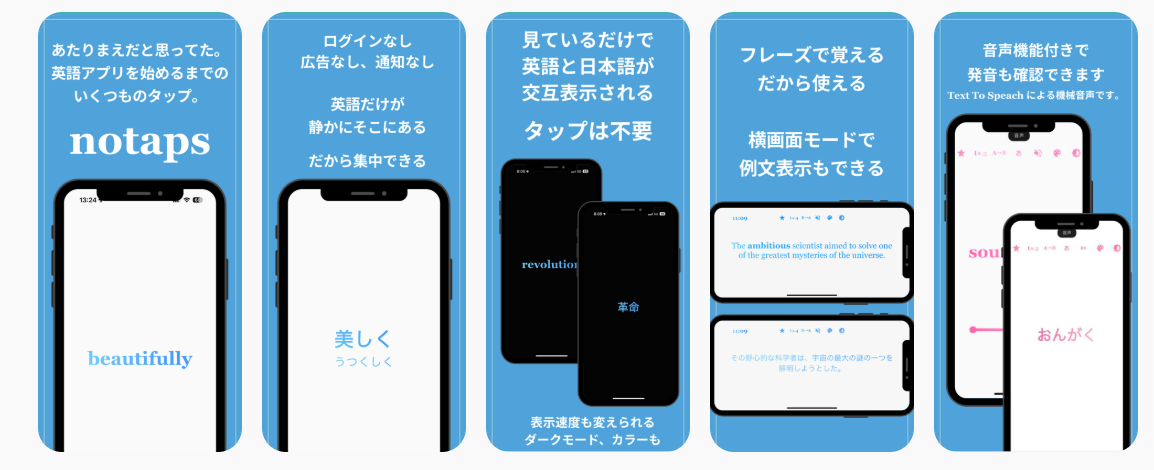
notaps — vocabulary that arrives as sound
notaps auto-plays a 15,000-word vocabulary list with French translations, so every word is learned with its spoken form attached. Offline, no ads, one-time purchase.
Build the ear-copy of your French.
Your reading French is real — it is just stored in the wrong format for conversation. Let the words you already know return as sound until both copies exist. That is when spoken French stops being a different language.