Japanese gets lighter when it keeps coming back.
A new language is hard when every session starts from zero. Kana, sound, meaning, and basic words need to return often enough that the next textbook page feels less heavy.

If you came from the thread
For Japanese learners, the early wall is not only grammar. Kana, sound, meaning, and basic words need repeated exposure. A passive vocabulary loop can make Japanese return without turning every session into a full study block.
The issue is often exposure frequency and friction, not only talent or motivation.
Instead of one heroic session, make words return in small repeatable moments.
Use Japanese vocabulary as a small passive loop before the next real study session.
The first win in Japanese is not fluency. It is lowering the cost of coming back tomorrow.
Basics are only basic after they become familiar
Hiragana, katakana, greetings, particles, and core nouns look simple on a syllabus. But for a beginner, each one still consumes attention. The basics become basic only after enough encounters.
One long session makes Japanese feel like an event
A full study block can help, but it also raises the activation cost. If Japanese only happens when you have perfect energy, the language disappears on busy days.
Small returns keep the language warm
Hearing a word, seeing its meaning, forgetting it a little, and meeting it again is not wasted time. It is the basic loop that turns foreign symbols into familiar words.
Treat Japanese vocabulary as a repeat loop
Wait for a perfect study session
You plan to study seriously later. Later becomes tomorrow. Tomorrow becomes next week. Japanese remains something you restart instead of something that stays warm.
Make Japanese reappear
You let words come back during tiny gaps: before a lesson, while walking, after dinner, or before sleep. The session is small, but the contact count grows.
A small loop for Japanese beginners
Hear
Let the Japanese word enter as sound first. Do not demand perfect recall immediately.
See
Connect kana, romaji if needed, and meaning while the sound is still fresh.
Return
Meet it again later. The word becomes less foreign through returns.
5 min
Five minutes is small enough to repeat. For Japanese learners, repeatability often matters more than the impressive size of one session.
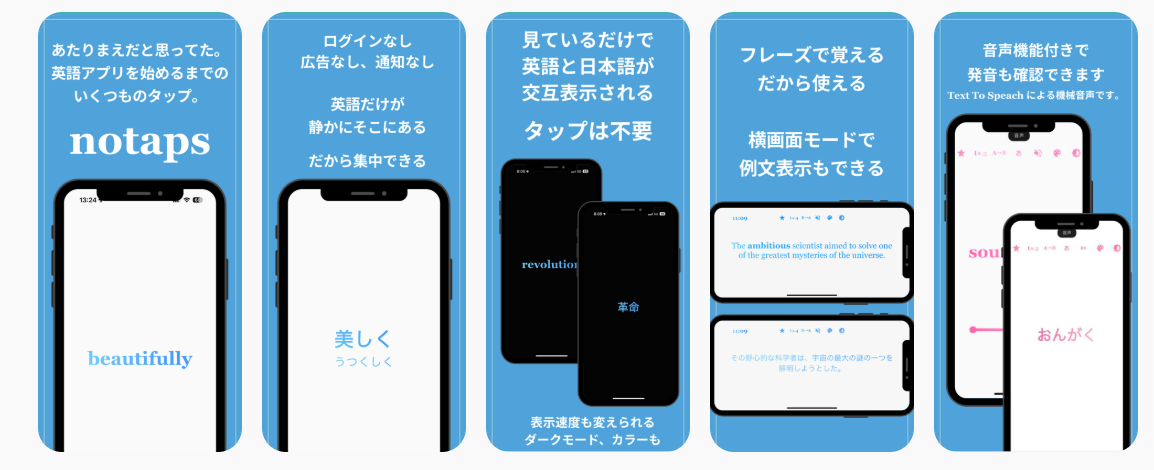
notaps supports global vocabulary loops, including Japanese
notaps is a passive vocabulary app for repeated exposure. It can auto-play words and meanings so Japanese can return in small moments without tapping through flashcards. Designed for global language learning, offline use, no ads, one-time purchase.
Japanese should not only live inside a textbook.
A textbook teaches structure. A repeat loop keeps words close enough to come back. When Japanese returns in small moments, the next serious session starts with less friction.