Japanese reading is hard when every word asks for attention.
N-level labels help, but reading actually changes when kana, kanji, vocabulary, and genre patterns stop consuming the whole screen of your mind.

If you came from the thread
Japanese reading is not only about grammar level labels. Kana, kanji, vocabulary, genre familiarity, and repeated exposure all decide how much attention is left for meaning.
The issue is often exposure frequency and friction, not only talent or motivation.
Instead of one heroic session, make words return in small repeatable moments.
Use Japanese vocabulary as a small passive loop before the next real study session.
Kana and kanji are visual load
Before a sentence can mean anything, the learner must recognize scripts. Kana becomes light first. Kanji takes longer because shape, reading, and meaning all have to connect.
Vocabulary is working-memory load
If every other word requires a lookup, the sentence cannot flow. The learner's attention stays at word level, leaving little room for plot, argument, or nuance.
Genre changes the difficulty
A textbook sentence, a game line, a tweet, and a novel can all be Japanese, but they ask for different vocabularies. Reading improves when words return inside the kind of material you actually want to read.
Do not treat reading as one skill
I am bad at Japanese reading
Everything feels equally difficult, so the problem looks like general talent. The learner cannot tell whether the block is kanji, vocabulary, grammar, or genre.
Find the layer that is expensive
If word recognition is expensive, train repeated vocabulary exposure. If grammar is expensive, slow down the sentence. If genre is expensive, collect words from that genre.
Free attention for meaning
Recognize
Make the word less visually foreign.
Hear
Attach sound and reading to the written form.
Read
Use the saved attention for sentence meaning.
1 layer
Japanese reading improves faster when you identify which layer is expensive. Many learners do not need a bigger plan first. They need one layer to become lighter.
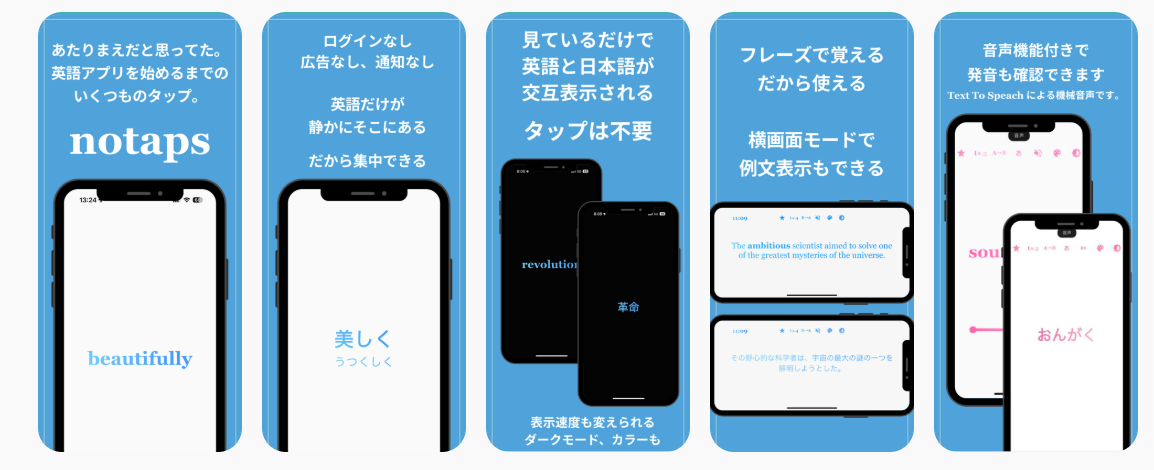
Make Japanese words return before you read
notaps creates repeated vocabulary exposure for global language learners, including Japanese. Use it to keep words, readings, and meanings returning in small sessions before you open a book, game, article, or test prep material.
Reading gets better when word recognition gets cheaper.
The goal is not to avoid grammar or kanji. It is to reduce the attention each familiar word demands, so the sentence can finally become meaning.