Korean gets hard after you can read Hangul.
The alphabet takes a weekend. The vocabulary takes years — unless you stop treating every word as a one-time memorization event and start designing for repeated encounters.
If you came from the thread
You can learn to read Hangul in a weekend. The real wall is vocabulary that shares almost nothing with English. Repeated sound-and-meaning exposure is the design answer.
The issue is often exposure frequency and friction, not only talent or motivation.
Instead of one heroic session, make words return in small repeatable moments.
Use Korean vocabulary as a small passive loop before the next real study session.
Hangul gives you an early win
King Sejong designed Hangul to be learnable, and it is. Most learners read their first words within days. Then comes the surprise: being able to read a word tells you nothing about what it means.
Almost no words come for free
A Spanish learner gets thousands of cognates as a gift. A Korean learner gets almost none. Outside of recent loanwords, every Korean word is new sound, new shape, new meaning — built from zero.
The wall is contact, not talent
When K-dramas sound like a wall of sound, the missing piece is usually not grammar. It is that the few thousand most frequent words are not yet automatic. That is a contact-count problem.
2,200 h
The US Foreign Service Institute groups Korean with the languages requiring the most classroom hours for English speakers — roughly four times its estimate for Spanish or French. The gap is mostly vocabulary and structure distance, not writing.
Korean vocabulary is a returns game
Grind a word list once
You sit down on a motivated evening and push through 80 new words. With no shared roots to anchor them, most are gone within days, and the next session starts with the discouraging feeling of re-learning.
Meet fewer words, more often
You let a smaller set of high-frequency words return as sound and meaning — while commuting, cooking, or winding down. Each return costs almost nothing, and familiarity compounds.
Hangul is a weekend project. Korean vocabulary is an environment project.
A small loop that survives busy weeks
See the Hangul
Read the word shape you already know how to decode. Reading skill becomes a hook for meaning.
Hear the sound
Let the spoken form play alongside. Korean you have heard is Korean you can catch in real audio.
Meet it again
Let the word come back tomorrow without a study session. Recognition grows on the return trips.
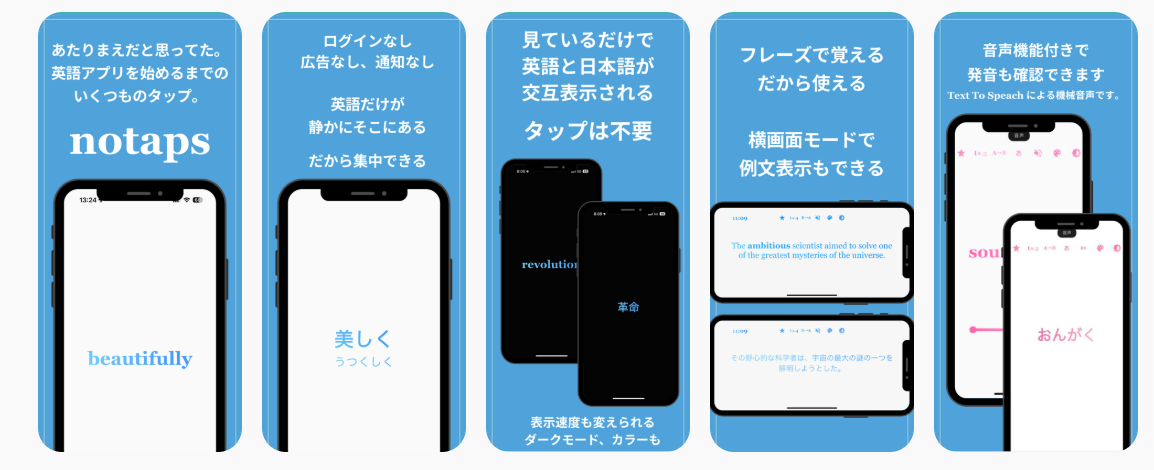
notaps — leave-it-on vocabulary, Korean included
notaps auto-plays a 15,000-word vocabulary list with Korean translations, so sound and meaning keep returning without flashcard taps. Offline, no ads, one-time purchase.
Keep Korean within earshot.
You do not need a heroic study block to make progress past Hangul. You need the most frequent words to keep showing up until they stop feeling foreign. Design the returns, and the drama subtitles start to lag behind your ears.