Vocabulary does not stick because you stared harder.
It sticks because you met the word, forgot it a little, and met it again. The design problem is not motivation. It is repeated exposure.

If you came from the thread
Vocabulary learning is not only about memorizing harder. Spacing, repeated exposure, and lower friction explain why a passive word loop can help.
The issue is often exposure frequency and friction, not only talent or motivation.
Instead of one heroic session, make words return in small repeatable moments.
Use repeated exposure as a small passive loop before the next real study session.
The hard part is starting
A textbook is powerful after you open it. The problem is everything before that: sitting down, choosing a unit, deciding what to review, and having enough energy to begin.
One big session creates one big gap
Many learners try to memorize a large batch of words in one sitting. It feels productive, but the next contact with those words may come too late.
Words need small returns
A word becomes familiar through repeated encounters. The second, third, and tenth meeting matter more than the heroic first attempt.
1885
Hermann Ebbinghaus showed that memory changes over time, and later research repeatedly found that spaced practice generally beats massed practice. Vocabulary is no exception.
Vocabulary is a contact problem
Memorize a list once
You push through 100 words when your motivation is high. The session feels intense, but the words have no easy path back into your day.
Create a repeat loop
You let words reappear while commuting, cleaning, stretching, or winding down. The session is smaller, but the number of encounters grows.
The best vocabulary system is not the one you admire. It is the one you actually encounter again tomorrow.
Forgetting is part of the loop
Forgetting is not a sign the session failed. It creates the condition for retrieval and re-encounter. A word that returns at the right time becomes less foreign.
Low friction keeps the loop alive
If every session requires a desk, a notebook, and a perfect mood, the loop breaks. Lower the activation cost and the learner returns more often.
Sound plus meaning builds a bridge
For many learners, seeing the word and hearing its translation together is not a weakness. It is an early bridge between form, sound, and meaning.
5 min
Five minutes is not magic. It is small enough to repeat. In language learning, the repeatability of the session often matters more than its heroic size.
A word becomes familiar through a small loop
Hear
Let the word enter as sound. Do not demand perfect recall on the first pass.
See
Connect spelling, sound, and meaning while the word is still fresh.
Return
Meet it again tomorrow, then again later. Familiarity grows through returns.
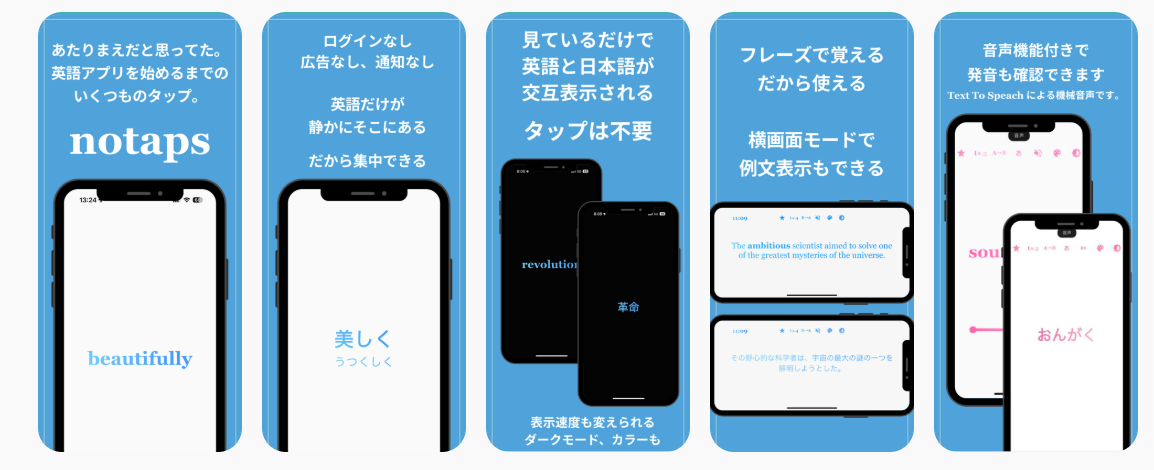
notaps — passive vocabulary for EN/JP
notaps auto-plays English words and Japanese meanings, so you can create repeated vocabulary exposure without tapping through flashcards. 15,000 words, offline, no ads, one-time purchase.
Do not only study harder. Make words return.
A good vocabulary habit is a system for repeated encounters. The smaller the friction, the more likely tomorrow's exposure happens.