You can read Spanish you cannot hear.
Cognates carry your reading far beyond your real level. Then a native speaker says the same sentence at full speed and the words you 'know' disappear. The fix is not more grammar. It is ear-level vocabulary.

If you came from the thread
Cognates make written Spanish feel friendly to English speakers, but spoken Spanish is fast. Closing the listening gap means binding word sounds to meanings through repetition.
The issue is often exposure frequency and friction, not only talent or motivation.
Instead of one heroic session, make words return in small repeatable moments.
Use repeated exposure as a small passive loop before the next real study session.
Cognates are a real gift
A large share of English vocabulary arrived through French and Latin, so written Spanish hands you thousands of near-free words: información, posible, universidad. On paper, you start far ahead of zero.
The gift does not transfer to your ears
Recognizing 'universidad' on a page is instant. Catching it inside a rapid sentence, squeezed between vowels and linked to the next word, is a different skill — one reading practice never trains.
Spoken Spanish is genuinely fast
Spanish packs more syllables into each second than English. If a word's sound is not automatic, the sentence has already moved on while you decode. Speed exposes every word you only know by sight.
~7.8/s
Cross-language speech-rate research measured Spanish among the fastest major languages at roughly 7.8 syllables per second, against roughly 6.2 for English. Spanish carries less information per syllable and compensates with speed — which punishes slow word recognition.
Train recognition, not just recall
Read and translate
You study Spanish mostly through text. Vocabulary tests go well. But every listening encounter still requires a silent translation step, and real conversation does not wait for it.
Hear words until they are instant
You let high-frequency words play as sound with meaning attached, again and again. Recognition stops being a translation step and becomes a reflex — which is what listening at native speed actually requires.
In Spanish, the question is not whether you know the word. It is whether you know it in 150 milliseconds.
From paper-knowledge to ear-knowledge
See the word
Anchor the spelling — often a familiar cognate shape you already half-know.
Hear it spoken
Attach the real sound to the shape: vowels, stress, and linking, not the English-ish version in your head.
Repeat to reflex
Let it return until recognition is instant. Fast speech only feels fast when lookup is slow.
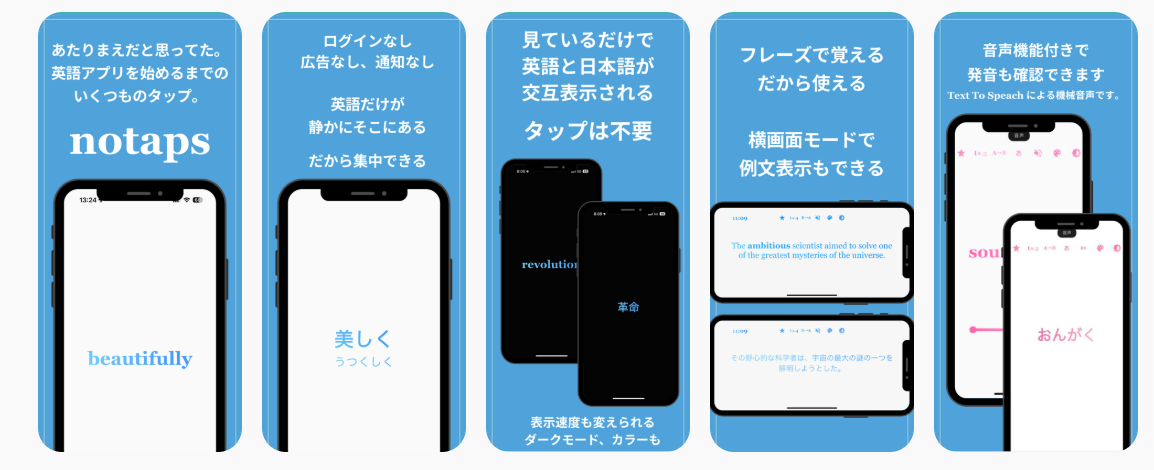
notaps — passive sound-first vocabulary
notaps auto-plays a 15,000-word vocabulary list with Spanish translations, building the sound-to-meaning reflex while you commute, cook, or rest. Offline, no ads, one-time purchase.
Give your ears the same hours you gave your eyes.
Reading built your Spanish foundation. Listening will not catch up by itself — it catches up when word sounds return often enough to become reflexes. Make the returns cheap, and full-speed Spanish starts resolving into words.